martes, 16 de junio de 2015

THE HABSBURG DYNASTY


         THE HASBURG DINASTY        


                                     INDEX


                             1. The Empire of Charles I

                             2. The Spanish Empire of Philip II

                             3. Economic and Society in the 16th century

                             4. The Declare of the Empire in the 17th century
                                              -Philip III
                                              -Philip IV
                                              -Charles II

                             5. Economic and Society crisis in the 17th century


                 1. The Empire of Charles I


1.1 HEIR TO AN EMPIRE 
  
Charles I of Spain, who was also Charles V of Germany, was the son of Joanna of Castile and the German prince Philip of Habsburg.

       -From his mother's side, the Kingdom of Castile, Navarre, the Crown      of Aragon and territories in America and Italy.

       -From his father's side, the Netherlands, Luxemburg and France-Comté. When his grandfather, the Emperor Maximilian, died, he also inhrited his German territories and was given the title of Emperor.


1.2 PROBLEMS WITHIN THE EMPIRE

Charles I ruled from 1516 to 1559 but took tittle interest in the Iberian Peninsula. Several revolts took place during his reign:

       -The Revolt of the Comuneros (1520-1521) was an uprising of nobles, the bourgeoisie and the peasants of Castile against the King's economic policy.

       -The Revolt of Brotherhoods (1521-1523) was a uprising of artisans and peasants in Valencia and Mallorca. The Artisans wanted access to goverment office and the peasants wanted better rental conditions.


1.3 PROBLEMS ABROAD 

     -He went to war with France (1525-1544) defeated the French army in the Battle of Pavia.
   
     -He fought the Turks (1529-1541).

     -He confronted the German princes, who supported Lutheran reform.


              2. The Spanish Empire of Philip II


2.1. PHILIP II'S GOVERMENT

      Philip II governed very differently from his father. He paid special attention to the interests of the Spanish monarchy and issued political orders from Madrid.

      Philip II extended the system of advisory councils. He also established royal officials calledcorregidors to represents royal authority in local areas.

       Philip II continued his father's fight against Protestantism. He used the Inquisitions to persecuted people suspected of not being true Catholic. of Philip's repression of Muslims converts in Andalusia led to the Morisco Revolt 1568, wich was suppressed in 1571.


2.2 FOREIGN POLICY


    -Against the French, who he defeated in the Battle of Saint-Quentin in 1557.

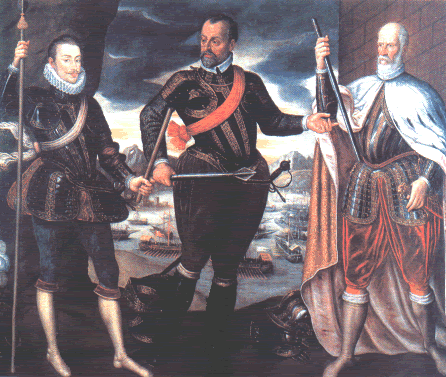
     -Against the Turks, who he defeated in the Battle of Lepanto in 1571.

     -Against England. He sent the Spanish Armada to invaded England, but the flet was destroyed in a storm.

     -Against Flanders. Philip II sent tercios to the area, but they were unabled to resolver the problem.

      When the king of Portugal died without an heir, Philip II annexed Portugal.


 3. Spanish economy and society in the 16th century


3.1 THE ECONOMY

     During the 16th century, large amounts of gold and silver were brought to Spain from America.


     An increased in the demand for goods from America led to growth in trade and commerce.

     Most trade took place in Castilian cities and Atlantic ports, such as Seville.


     Most of the land belonged to the aristrocracy or the Church and was used mostly for livestock farming.


3.2 SOCIETY.

   In the 16th century, the population of Spain increased, specially in Catile.

   The privileged class was made up of nobles and clergy, who owned most of the lands. Eighty percent of the population were peasants, who paid taxes and had limited rights.


4.The decline of the Empire in the 17th century.

 
4.1 PHILIP III: THE GOVERMENT OF FAVOURITES

        Monarchs in the 17th century left governed to favourites, who became very powerful ministers.


4.2 PHILIP IV: THE END OF EUROPEAN DOMINANCE

         Philip IV appointed the Count-Duke of Olivares as his favourite. He wanted to maintain Habsburg dominance in Europe.

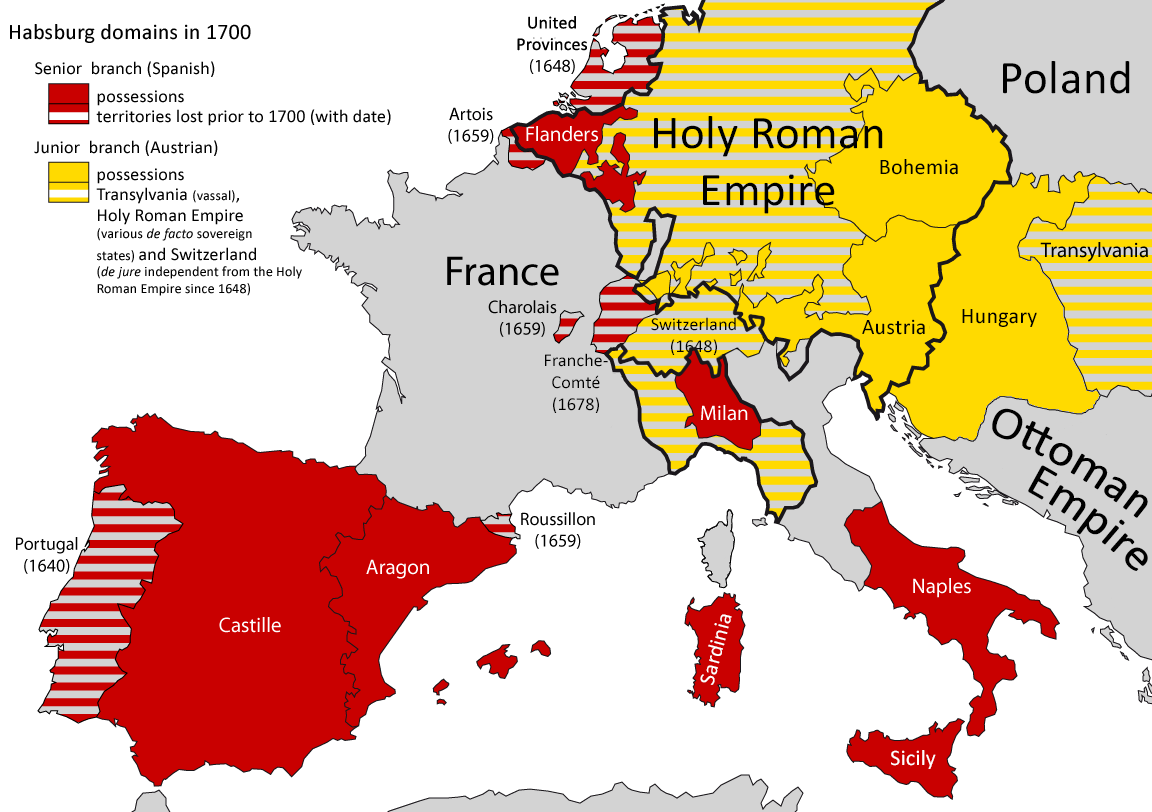
         The war ended with the signing of the Peace of Westphalia treaty in 1648, in which Spain recognised the independence of the Netherlands.

         In Ansalusia the revolt was suppressed, but Portugal managed to separate from the Spanish Crown with support from England and France.

        Catalonia also received help from the French and the ensuing conflict continued until 1652. The war between Spain and France finally ended with the singing of the Teatry of the Pyrenees in 1659, in which Roussillon and Artois became part of France.


 4.3 CHARLES II: CRISIS IN THE HABSBURG MONARCHY

        Spain experienced a period of crisis during the regin of Charles II, Spain's last Habsburg monarch. This crisis was caused by the king's incompetence, corruption among his favourite and a number of economic problems.

      When Charles II died without an heir in 1700, the War of the Spanish Succession broke out between Philip of France's Bourbon dynasty and Charles of Austria. The victory of the French brought an end to the Habsburg monarchy in Spain.


5. Economic and social crisis in the 17th century


5.1 CRISIS IN THE CROWN OF CASTILE

      In the 17th century, there was a sharp decrease in the population of Castile because of emigration to America.

      As agricultural conditions worsened, may peasants moved to cities. Livestock farming also suffered, after years of war and drought had destroyed pastureland.

     During this period, industry and trade decreased significantly.

     While the nobles acquired more new propety and other luxuries, the peasantsartisants andhidalgos srtuggled to survive the economic crisis.


5.2 THE CRISIS AND THE CROWN OF ARAGON

     This crisis did not have the the same effect on places like aragon, which had not been central to American trade. In the 17th century, Aragon's more stable economy allowed new trading companies to appear, and a silk textile indrusty also began.


Realizado por: Ramón Pecero Suárez y Alba Ortiz Sanchez.

miércoles, 20 de mayo de 2015

OTHER EXPLORERS

-Vasco Nuñez de Balboa:
 
     Vasco Nuñez de Balboa was born in 1475 in the frontier town of  Jerez de los Caballeros.
     It was the first European to see the Pacific Ocean from its  eastern  coast and the first European city to establish a    permanent American mainlands.
    He died in January 1519, in Acla, Panamá.


-Amerigo Vespucci:
     
   Amerigo Vespucci was born in 1454 in Florence.
    He died in 1512 in Seville.
      He held important positions in the House of Trade in Seville,        which was named "Chief Pilot" in 1508; but its universal fame is    due to two works published under his name between 1503 and        1505: the Mundus Novus and the letter to Soderini, who            attributed   a leading role in the discovery of America and its    identification as a new continent. For this reason the    cartographer Martin Waldseemüller in his map of 1507 coined        the name "America" in his honor as a designation for the New    World.


-Ferdinand magellan:

   Ferdinand Magellan was born in 1480 in Portugal.
    He died in 1521 in the Philippine Islands.
    It was a military, marine and Portuguese navigator of noble      lineage, named by Hispanic Monarchy advance, commander in  chief of the "Armada for discovering the spices' and knight of the    Order of Santiago.
      The service of Charles I, discovered the natural channel    navigable today called Strait of Magellan, the first European to go  sailing from the Atlantic Ocean to the Pacific Ocean, previously  called South Sea. He began the expedition, led to his death by Juan  Sebastian Elcano, to achieve the first circumnavigation of the    Earth in 1522.


-Juan Sebastián Elcano:

   He was born in 1476 in Guipuzcoa.
    He died in 1526 in the Pacific Ocean.
     He was a Spanish sailor who participated in the first round the      world, being at the head of the expedition after the death of        Ferdinand Magellan.

martes, 3 de marzo de 2015

THE PRINTINGS PRESS

The Renaissance spread to Germany, France, England, and Spain in the late fifteenth and the sixteenth centuries. In its migration northward, Renaissance culture adapted itself to conditions unknown in Italy, such as the growth of the monarchical state and the strength of lay piety. In England France, and Spain, Renaissance culture tended to be court-centered and hence anti-republican. In Germany, no monarchical state existed but a vital tradition of lay piety was present was present in the Low Countries. The Brethren of the Common Life, for example, was a lay movement emphasizing education and practical piety. Intensely Christian and at the same time anticlerical (shades of what was to come!), the people in such movements found in Renaissance culture the tools for sharpening their wits against the clergy -- not to undermine faith, but restore its ancient apostolic purity.
Northern humanists were profoundly devoted to ancient learning but nothing in northern humanism compares to the paganizing trend associated with the Italian Renaissance. The northern humanists were chiefly interested in the problem of the ancient church and the question of what constituted original Christianity.
Two factors operated to accelerate the spread of Renaissance culture after 1450: growing economic prosperity and the printing press. Prosperity -- the result of peace and the decline of famine and the plague -- led to the founding of schools and colleges. In these schools the sons of gentlemen and nobles would receive a humanistic education imported from Italy. The purpose of such an education was to prepare men for a career in the church or civil service.
Sometime in the 13th century, paper money and playing cards from China reached the West. They were "block-printed," that is, characters or pictures were carved into a wooden block, inked, and then transferred to paper. Since each word, phrase or picture was on a separate block, this method of reproduction was expensive and time-consuming.
The extension of literacy among laypeople and the greater reliance of governments and businesses upon written records created a demand for a less-costly method of reproducing the written word. The import of paper from the East as well as "block-books" (see above), were major steps in transforming the printing of books. However, woodcuts were not sufficiently durable as they tended to split in the press after repeated use. Furthermore, a new block had to be carved for each new impression, and the block was discarded as unusable as soon as a slightly different impression was needed.
By the middle of the 15th century several print masters were on the verge of perfecting the techniques of printing with movable metal type. The first man to demonstrate the practicability of movable type was Johannes Gutenberg (c.1398-1468), the son of a noble family of Mainz, Germany. A former stonecutter and goldsmith, Gutenberg devised an alloy of lead, tin and antinomy that would melt at low temperature, cast well in the die, and be durable in the press. It was then possible to use and reuse the separate pieces of type, as long as the metal in which they were cast did not wear down, simply by arranging them in the desired order. The mirror image of each letter (rather than entire words or phrases), was carved in relief on a small block. Individual letters, easily movable, were put together to form words; words separated by blank spaces formed lines of type; and lines of type were brought together to make up a page. Since letters could be arranged into any format, an infinite variety of texts could be printed by reusing and resetting the type.
By 1452, with the aid of borrowed money, Gutenberg began his famous Bible project. Two hundred copies of the two-volume Gutenberg Bible were printed, a small number of which were printed on vellum. The expensive and beautiful Bibles were completed and sold at the 1455 Frankfurt Book Fair, and cost the equivalent of three years' pay for the average clerk. Roughly fifty of all Gutenberg Bibles survive today.
In spite of Gutenberg's efforts to keep his technique a secret, the printing press spread rapidly. Before 1500 some 2500 European cities had acquired presses. German masters held an early leadership, but the Italians soon challenged their preeminence. The Venetian printer Aldus Manutius published works, notably editions of the classics.
The immediate effect of the printing press was to multiply the output and cut the costs of books. It thus made information available to a much larger segment of the population who were, of course, eager for information of any variety. Libraries could now store greater quantities of information at much lower cost. Printing also facilitated the dissemination and preservation of knowledge in standardized form -- this was most important in the advance of science, technology and scholarship. The printing press certainly initiated an "information revolution" on par with the Internet today. Printing could and did spread new ideas quickly and with greater impact.
Printing stimulated the literacy of lay people and eventually came to have a deep and lasting impact on their private lives. Although most of the earliest books dealt with religious subjects, students, businessmen, and upper and middle class people bought books on all subjects. Printers responded with moralizing, medical, practical and travel manuals. Printing provided a superior basis for scholarship and prevented the further corruption of texts through hand copying. By giving all scholars the same text to work from, it made progress in critical scholarship and science faster and more reliable.


lunes, 23 de febrero de 2015

MEDIEVAL INSTITUTIONS IN SPAIN.

The institutionalization of the feudal monarchy included the creation of the Courts, extension of the Curia Regis to set up a representative assembly of the nobility, clergy, and the cities of each realm. The alternatives of dynastic politics determined inheritances and marriages that divided and merged kingdoms (Castilla y León repeatedly until final unification with Fernando III "the Saint"). Faced with greater inner power that managed to accumulate the kings of the Crown of Castile, opposite case was that of Aragon turned into kingdom after its separation from Navarra, the military orders of the testament of Alfonso been met could have become a territory by I Fighting; nobles agreed to ignore it, and raise the throne Ramiro II the Monk (the legendary bell Huesca) who, a year to ensure the succession to the birth of his daughter Petronila, agreed to her marriage to the Count of Barcelona Ramon Berenguer IV , who left the government of the kingdom, returning to his monastery (in 1137 -the wedding had to wait thirteen years). The resulting political entity (Crown of Aragon) was incorporating the successive conquests of such separation criteria: federal territories with different institutions.


martes, 25 de noviembre de 2014

Warrior nobility: a privileged group.

In feudal society, the main function of the nobility, and the king himself, was to be warriors. Are the knights who were engaged in trade of arms. Have the equipment, horses and weapons was very expensive and only the feudal lords could perform that office.

The sons of noble families were educated and trained as warriors. Were pages and squires after other gentlemen first.

Alos eighteen years were named knights in the investiture ceremony in which they received their weapons: sword, shield and chainmail. From that moment, would be part of knighthood and should be brave, loyal to his master and defend the weak and women.

The nobles made war to defend their territory or ortho help the monarch or lord who owed allegiance. The war provided, if won, land and wealth which enhanced the power of the nobility (booty).

Their social function allowed the nobility live with privileges. They had to work, did not pay taxes and were the only ones who could give them weapons and exercise control over the rest of the population.

Women, even if they were of noble family, were subject to men, either the father or husband. They could inherit, and in the absence of men, to be holders of fiefs, but usually their marriage accorded with a noble and lands passed into the property of the husband's family

jueves, 6 de noviembre de 2014

The Five Pillars of Islam :

  1. Shahadah: declaring there is no god except God, and Muhammad is God's Messenger
  2. Salat: ritual prayer five times a day.
  3. Zakat: giving 2.5% of one’s savings to the poor and needy.
  4. Sawm: fasting and self-control during the holy month of Ramadan.
  5. Hajj: pilgrimage to Mecca at least once in a lifetime if one is able[7]

martes, 14 de octubre de 2014

MUHAMMAD

Muhammad was born in the year 570 in the town of Mecca, a mountain town in the high desert plateau of western Arabia. His name derives from the Arabic verb hamada, meaning "to praise, to glorify." He was the first and only son of Abd Allah bin Al-Muttalib and Amina bint Wahb. Abd Allah died before Muhammad's birth and Muhammad was raised by his mother Amina, who in keeping with Meccan tradition entrusted her son at an early age to a wet nurse named Halima from the nomadic tribe of the Sa'd ibn Bakr. He grew up in the hill country, learning their pure Arabic.